Lead Your Space.
Light Your Senses.
Elystien |ə-LYS-tee-ən|
Cognitive Hospitality Design and Delivery Studio
Niagara, Ontario
We practise Cognitive Sanctuary Design, the discipline of building environments whose spatial conditions produce a measurable shift in how a guest thinks, moves, and stays.
The space determines how long a guest stays. How long they stay determines what they spend. We design for that.Niagara's hospitality properties are well-built. Most are underperforming, not from poor aesthetics, but because the furniture, the material sequence, and the guest journey were never designed as one system. Guests stay less time than they should. Spend less than they would. Leave without a reason to return.That is a cognitive design problem. We solve it, from specification through to handover, across a single property or an entire corridor.
TWO SERVICES. ONE FRAMEWORK.
Both services are expressions of a single discipline: Cognitive Sanctuary Design, the actual spatial conditions under which a guest's mind slows, attends, and stays. Not comfort. Not ambience. Threshold, material, acoustic register, and light behaviour, specified from first principles, held through delivery, and measured by what guests do after they arrive.The Liquid Maple Lab Cognitive Design Framework (LMLCDF) is the methodology that governs every specification and sequencing decision within both services. It is what separates environments that produce measurable outcomes from those that meet a visual brief.
Full design-to-installation of furniture, FF&E, material, and lighting systems, specified and delivered according to cognitive sequencing logic.
Experience architecture across multiple operators, designed to produce coherent guest journeys that increase dwell time, drive return visitation, and create a bookable destination product.
WHY NIAGARA. WHY NOW.
Niagara has the operators. It does not yet have coherence. Every tasting room has arrived at the same destination: reclaimed wood, ambient lighting, and local product. The aesthetic language has converged. When spaces feel interchangeable, guests decide on price and proximity, and no operator wins that comparison.The next issue is structural. Visitors move across four to six properties in a single day. What they carry from one stop to the next, the emotional arc, the cumulative experience, the reason to return, is currently left to chance. No one has designed it.What that costs:
• Undifferentiated spaces reduce dwell time and per-visit spend. And without experiential coherence, visits become one-time events
• Operators compete on price rather than experience depth, while regional tourism bodies cannot build a destination narrative from disconnected properties, although individually strong.
• So, Niagara loses market position to corridors investing in experiential infrastructure nowThis is not an aesthetic problem. It is a cognitive design problem. And it is solvable.
SERVICE 1
Cognitive Furniture & Hospitality Interiors
Objects that earn their place.
Most hospitality procurement follows the same logic: budget, lead time, and reference image. That logic produces spaces that photograph correctly and perform below expectations. Guests cannot identify the problem. They stay less, spend less, and do not return. The failure sits below the threshold of conscious notice, in the sequencing of material encounters, the acoustic register of a room, the weight and temperature of a surface, the pacing of the spatial journey from arrival to departure.These are not “finishing” decisions. They are structural ones. And they are where most operators leave the most value behind.
What We Do
Elystien designs, sources, fabricates, and installs furniture, FF&E, lighting, textiles, and material systems for hospitality environments.We are the accountable delivery partner from experiential logic through to occupancy-ready handover.Every specification decision is evaluated against the LMLCDF: the sequencing, pacing, material affect, acoustic condition, and light behaviour that determine how a guest thinks, moves, and stays within a space.Procurement pressure does not change the specification. Contractor substitution does not change the specification. The logic holds from concept to the last object placed.
In Practice
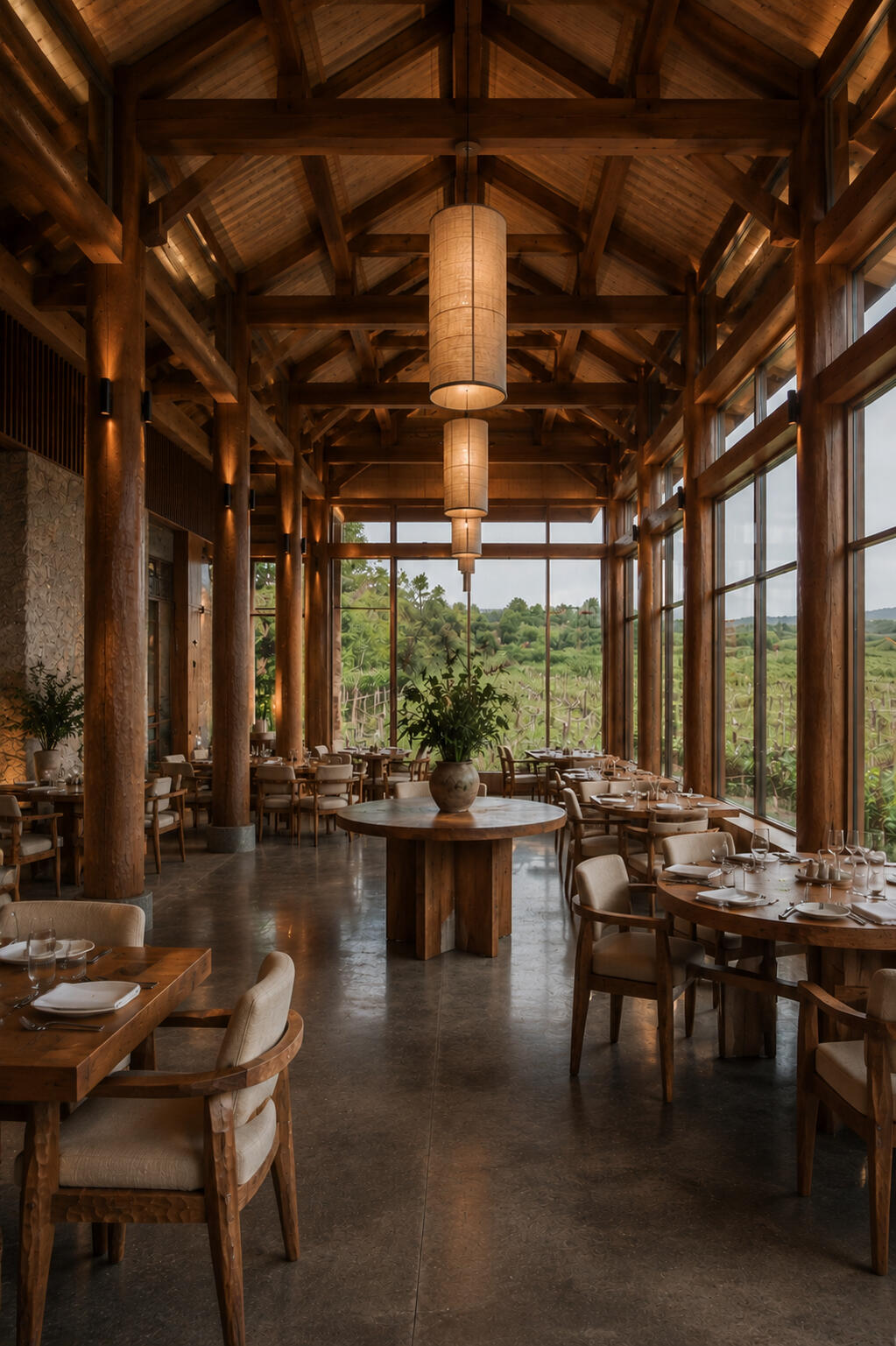
Winery tasting room
Material encounter sequenced, arrival surface, primary seating during the pour, the surround when conversation slows, so the room accumulates the way a great vintage does. Longer stays. Higher per-visit spend. Stronger emotional association with the property.Boutique hotel or resort
Furniture, textile, lighting, and finish specified as one coordinated system, not separate vendor decisions assembled on site and hoped to cohere. Room operators defend at a premium rate, and that hold that rate on return visits.Residential villa
Hospitality-grade cognitive sequencing applied to private life. For owners who know what the world's best properties feel like from the inside, and want their home to perform at that level.
What You Receive
Design & Specification
• Cognitive furniture curation report, every piece evaluated against LMLCDF sequencing criteria
• Full FF&E schedule, specification, finish, sourcing, lead time
• Material affect matrix, performance mapped across light conditions, acoustic environment, and seasonal variation
• Sensory sequencing plan, material encounter logic from guest arrival through departureCompliance & Documentation
• Professional-standard interior design documentation
• BCIN permit-ready construction drawings, produced in-house, with no third party between design intent and permit submission
• Material coordination package for contractor useProcurement & Fabrication
• Supplier sourcing and relationship management
• Custom fabrication coordination and bespoke piece oversight
• Procurement schedule and logistics management
• Quality control at the fabrication and pre-installation stagesInstallation & Handover
• Full installation management and site oversight
• Design intent held to the last object placed, no substitutions without documented approval
• Occupancy-ready handover with complete documentation record
Business Outcomes
• Longer dwell time — achieved through seating, pacing, and acoustic logic designed for lingering.
• Higher spend per visit — because guests who stay longer naturally spend more.
• Stronger repeat visitation — created by coherent sequencing that forms spaces guests want to return to.
• Reduced procurement risk — through specification logic that identifies misalignment before purchase.
• Permit confidence — supported by BCIN documentation produced in‑house with no third‑party delay.
• Single accountable delivery partner — eliminating coordination gaps across design, procurement, and installation.
Well-suited for
Winery tasting rooms and event facilities · Boutique hotels and resort developments · Farm-to-table restaurants · Agritourism properties · Residential villas and high-end private retreats · Developers requiring one accountable design-to-delivery partner · Properties replacing an underperforming material environment.If your space is underperforming and you are not sure why, that is the right starting point. A focused first conversation. No obligation to proceed.One property, or the entire corridor. The logic scales.[email protected]
Subject: Interiors
Both services work because they share the same foundation.
SERVICE 2
Multi-Site Experiential Journeys
The experience no single property can deliver alone.
Visitors to Niagara's Wine Route move through four to six properties in a single day and leave with nothing that holds. Not because the properties fail, but because no one has designed what moves between them.The emotional arc. The cumulative narrative. The sense that the day is building toward something. That is currently undesigned. Guests construct their own meaning from disconnected encounters, and thin meaning does not produce return visitation.This is not a marketing problem. It is a design problem.
What We Do
Elystien designs experience architecture across multiple operators, the sequencing logic, the emotional arc, the on-site programming at each node, the transitions between stops, and the cognitive coherence that makes a full day of encounters perform as one experience greater than its parts. This is not a tour map. It is not a tour package.It is the structural logic of a guest journey, grounded in the LMLCDF and applied to the specific geographic and operational conditions of Niagara's corridors.
What Makes This Different
Conventional visit → Cognitive Multi‑Site Journey
• Schedule, map, logistics → A designed arc from arrival to final stop
• Each stop is independent → Each operator becomes a distinct chapter in a larger sequence
• Transitions are navigation → Transitions are designed experiences
• Guest constructs meaning alone → Coherence is built into the structure
• A pleasant day → An experience guests return to completeThe guest who moves through a designed sequence carries something no single property could have given them. That is the return reason. The referral driver. The product a tourism body can name and sell.
The Niagara Advantage
Wine Route operators, agritourism properties, conservation areas, and farm-to-table destinations within 45 minutes of each other. Geographic density this favourable for journey design is rare.The operators exist. The infrastructure exists. The experiential logic that connects them does not. That gap is available to whoever designs it first.
What You Receive
Journey Architecture
• Full multi-site route design, cognitive sequencing plan, and emotional arc from first arrival through final stop
• Sensory register profile per operator node — how each property contributes a distinct chapter to the larger sequence
• Transition design brief — the designed experience between stops, not only at themOperator Alignment
• On-site experience programming and integration sessions per participating operator
• Contribution guidelines — how each node fits and functions within the larger journey logicDeployment & Scale
• Field lab prototyping and cohort testing before launch, with structured iteration
• Licensing and replication framework for tourism bodies building scalable regional product
• DMO and regional tourism body integration
Journey Formats
Signature Journey
A named, multi-site experience built for a specific operator cluster or tourism body. Designed once. Runs repeatedly. A bookable destination product with its own identity.Operator Partnership Route
A modular framework individual operators join, each contributing a defined node to a coordinated whole. Scalable and defensible as a regional asset.Research & Prototype
A Field Lab engagement, journey sequence designed, tested with a validation cohort, and refined before full deployment. For tourism bodies and developers building new destination products.
Business Outcomes
• Higher dwell time per operator — guests given a designed reason to stay at each node, not just pass through.
• Repeat visitation — the journey becomes the return reason, not the individual property.
• New bookable revenue line — a named journey is a product with its own price and market.
• Regional differentiation — Niagara positions as a coherent destination, not a list of wineries.
• DMO destination narrative — a structured product tourism bodies can name, sell, and build campaigns around.
Well-suited for
Regional tourism bodies and DMOs · Winery and agritourism operator clusters · Conservation areas and land-based operators · Municipalities developing experiential tourism infrastructure · Boutique hotel operators extending the guest experience beyond their property boundary · Tourism developers building scalable regional product.If you operate within Niagara’s corridor and are open to what a designed journey could do for your property, we are interested in that conversation.[email protected]
Subject: Journey
THE FRAMEWORK
Liquid Maple Lab Cognitive Design Framework
The methodology behind both services.
Twenty years across Southeast Asian resort and hotel markets produced one consistent finding:
The environments guests remembered, returned to, and described to others were never the most elaborate. They were the most coherent.Every element, material, light, acoustic condition, spatial sequence, and pacing is aligned. Not for visual consistency. For the guest's interior state, how they think, feel, and move through the experience from arrival to departure. The LMLCDF formalizes that discipline.Developed through applied fieldwork across Southeast Asia. Refined through graduate research in Tourism and Hospitality Management. Validated in Niagara. Continuously developed through the Liquid Maple Lab.It provides the specification logic for the Cognitive Furniture & Hospitality Interiors Service and the sequencing architecture for the Multi-Site Experiential Journeys Service. It is what separates environments that produce measurable outcomes from those that meet a visual brief.
What it governs
Sensory sequencing
The order in which a guest encounters material, light, sound, and scale. Designed correctly, guests engage from the first moment. Left to chance, the space reads as generic in thirty seconds and does not recover.Spatial pacing
How the structure of movement through an environment controls anticipation, arrival, and length of stay. Designed correctly, dwell time increases without additional staff intervention. Left to chance, guests move through and leave.Material affect
How surface, texture, weight, and finish communicate quality and belonging before a word is spoken or a price is seen. Designed correctly, the environment earns its rate. Left to chance, guests register a disconnect they cannot name, and do not return.Acoustic condition
How ambient sound creates presence, privacy, and the permission to slow down. Designed correctly, guests linger. Left to chance, acoustic friction produces early departure.Light behaviour
Natural and artificial rhythms that anchor a guest's sense of time, place, and ease. Designed correctly transitions across a visit to deepen the experience. Left to chance, they interrupt it.This is the framework. The Lab is where it is built.
Research collaboration is available to institutions, regional tourism bodies, and development organizations. Defined scope. Mutual contribution.
FIELD LAB
Liquid Maple Lab
Where the framework is built, tested, and refined.
The Liquid Maple Lab is Elystien’s applied research and prototyping environment in the Niagara Region. It runs in parallel with our client practice — the site where the LMLCDF is stress-tested against real conditions, cognitive instruments are built and field-validated, and journey prototypes are run before deployment.This is where we work on the harder problem: not how to make a guest comfortable, but how to design environments that restore the conditions in which sustained attention, reflection, and genuine rest become possible. We call this Cognitive Sanctuary Design.Cognitive Sanctuary Design is the discipline of building environments whose spatial conditions — threshold logic, material weight, acoustic register, and the deliberate absence of demand — produce a measurable shift in a guest’s cognitive state. Not comfort. Not ambience. The actual conditions under which a mind slows, attends, and rests.It is the scientific and spatial foundation beneath both services. In Cognitive Furniture & Hospitality Interiors, it governs how material sequence and sensory encounter are specified to hold a guest beyond the moment of arrival. In Multi-Site Experiential Journeys, it governs how the arc between operators is designed so that the cumulative experience does something to a guest that no single property could produce alone.The environment does not invite the experience. It produces it. And Eon Tent is Cognitive Sanctuary Design's first built expression.
IN DEVELOPMENT
Eon Tent
Cognitive Instrument · Niagara Region
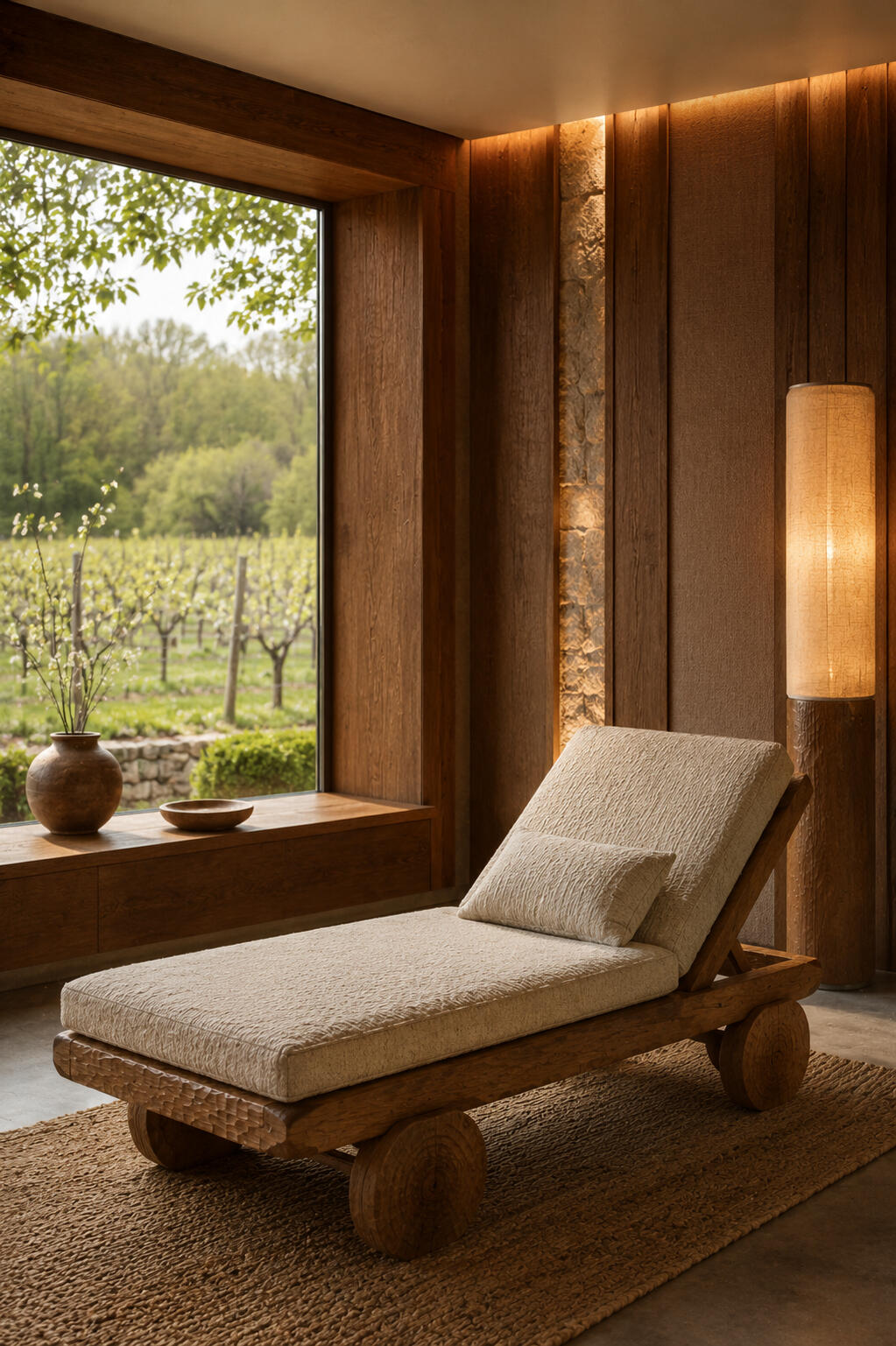
A self-contained environment for structured reflection. No screen. No data connection. No facilitation required. Nothing enters. Nothing leaves.Eon Tent is not a wellness amenity. It is a designed cognitive threshold, a bounded space where the environment itself does the work of slowing a guest’s mind to the point where genuine thought becomes possible.For a guest
A rare and repeatable experience of mental clarity, structured entirely by spatial conditions rather than programming or staff.For an operator
A signature offering that cannot be replicated from a catalogue, does not depend on service delivery to perform, and gives guests a reason to return that no other property in the corridor can offer.Select development and licensing partnerships are open.If you are an individual interested in experiencing Eon Tent when it opens to the public, leave your name.[email protected]
Subject: Eon Tent
THE FOUNDATION
We restore the conditions in which minds can think.
Clarity is the rarest form of luxury.
Twenty years of resort and hotel design and delivery across Southeast Asian markets where ultra-luxury properties operate at international delivery standards with no tolerance for specification error, no contingency cover, and no second chances with guests who have stayed at the world's best. That is where the discipline was built.Niagara's hospitality corridor is at an earlier stage of that same arc. The properties are well-built. The guests are increasingly discerning. And the gap between a space that performs and one that merely looks correct is exactly the gap that twenty years of high-stakes delivery teaches you to close.Graduate research in Tourism and Hospitality Management. Applied research through the Liquid Maple Lab in Niagara.No other studio in Ontario holds this combination: resort-scale delivery experience, a proprietary cognitive design framework grounded in graduate-level research, BCIN registration for permit-ready documentation produced in-house, and an active applied research program in the Niagara hospitality corridor.We are not a generalist studio with hospitality added to the portfolio. We are a cognitive hospitality design and delivery practice, built entirely around what makes a guest environment perform, worth the drive, worth the rate, and worth returning to.How we work
As a design-delivery partner with architects, contractors, operators, and tourism bodies, or as the lead authority when the project requires it.Each engagement is focused, confidential, and scoped clearly from the first conversation. No obligation to proceed.Engage
Elystien takes a limited number of engagements each year. Fit over volume.If you are building, furnishing, or programming a hospitality environment in Ontario or across North America, and guest experience performance is a genuine business priority[email protected]
Subject: Engage
Niagara, Ontario, Canada · Working across North America
Cognitive Furniture and Hospitality Interiors · Multi-Site Experiential Journeys · Liquid Maple Lab Cognitive Design Framework · Eon Tent
Elystien.com · © 2026 Elystien · All rights reserved